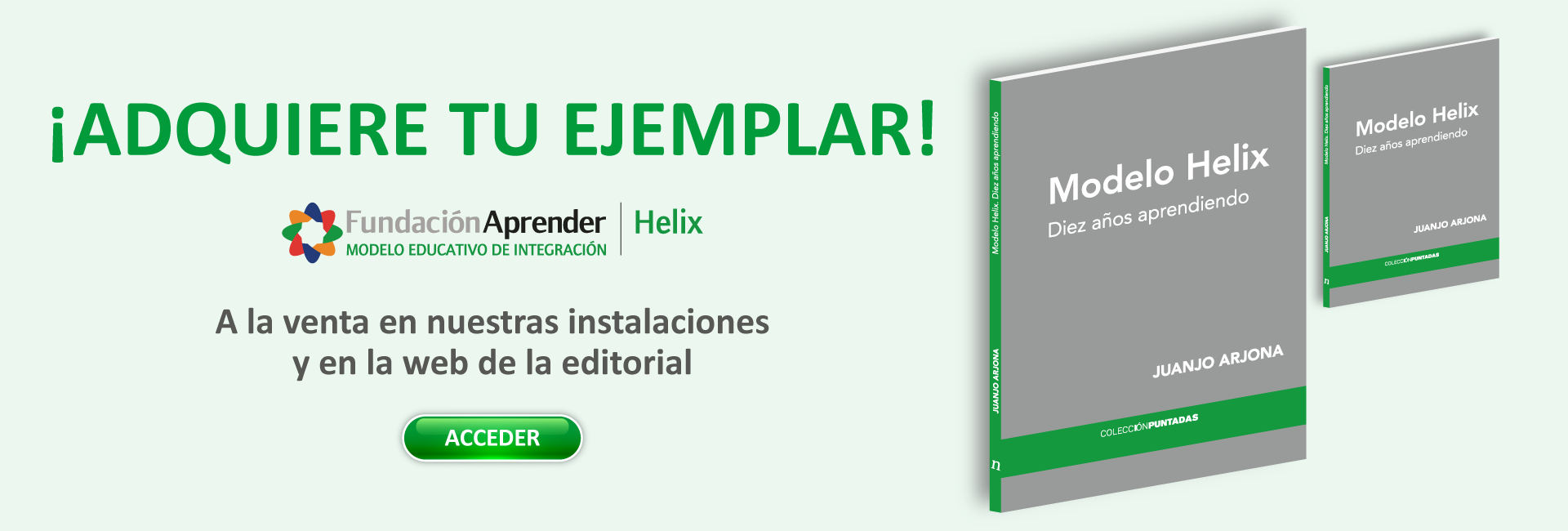
Educational project: Helix model
From innovation to the essence of education

The Helix model, developed at Brotmadrid, was born as a firm commitment to developing and expanding our school’s working method. Since 2011, it has served students who need an alternative to the traditional method, the reproductive school, and has achieved a successful model.
With the Helix model, we learn cooperatively, through challenges or problems; through research; observing our surroundings, making, manipulating, associating, and expressing what we’ve learned through models, lectures, artistic expressions, and so on. We use the teacher as a guide in the classroom, accompanying, sparking interest, helping students understand the why, teaching them how to think… Everyone always enjoys every activity! Through close-knit experiences, understanding the principles and content and connecting them to their reality, thereby achieving deeper learning.
In collaboration with experts, teachers, educational centers, those affected by specific learning difficulties (SLD), and families, as well as with various universities, we promote research by promoting theoretical and experimental work and conducting scientific studies that allow for the establishment of reliable data and improvements in teaching.
To continue growing and improving, we need research in the field of SLD to be a constant feature of our Aprender Model project, an open project, always in a continuous process of advancement, which encompasses the Corat Assessment Model and the Helix model for schools.
Because improving learning difficulties outside of school—with oneself, with family, at home, on the street—is just as important as educational renewal and innovation in the classroom with active methodologies: research, discovery, experimentation, association, and expression.
MAIN OBJECTIVE
Our main objective is to ensure that children with normal intelligence, whether or not they have dyslexia, achieve academic success. This entails:
- Achieving the objectives of the curriculum design, specifically considering the cognitive and practical difficulties of our students. We seek to achieve the same objective but in a different way, through different paths.
- Developing each student’s cognitive abilities through the appropriate methodology: the Helix model.
- Developing competency-based skills, not just academic ones: relating to others, assuming responsibilities, collaborating, confronting and solving problems, developing critical thinking, being creative, innovative, entrepreneurial, and so on.
- Fostering or, if applicable, restoring students’ psycho-affective stability, achieving greater security and self-confidence with higher self-esteem.
- Ensuring that students learn and enjoy doing so, and positively value their progress, overcoming the lack of motivation and sense of failure so characteristic of students with dyslexia.


Brotmadrid School
Brotmadrid is a regular, state-subsidized primary and secondary school (private baccalaureate), with priority given to students with specific learning difficulties (SLD): dyslexia, dyscalculia, attention deficit disorder, and other SLDs. An innovative school with a unique, innovative methodology: the Helix model, which leads to academic success.

Zola Valdemorillo School
Zola Valdemorillo School (Colegio Jara from 2018 to 2025) is the first mainstream school to replicate our Aprender Helix model, a model for those seeking to learn differently. Its current offerings range from Early Childhood (2 years) to the Baccalaureate in Arts and Sciences, and the Intermediate Vocational Training program “Technician in Natural and Leisure Environment Guidance” and “Microcomputer Systems and Networks”.

Melilla | Vetonia and Seneca Centers
The Vetonia and Seneca academies in Melilla offer the Helix model as part of their second-chance programs for young people over 17 who need to reconnect with their personal, educational, or professional development.

Perú | Niños del Arco Iris Foundation (Urubamba, Cusco), IE Miguel Grau (Isla Amantaní, Puno), Pachacútec Foundation (Lima) and Muyuy Tejiendo Tribu
At the Niños del Arco Iris Foundation (Cusco) and Miguel Grau Elementary School (Puno), teacher training and implementation of the Helix model were carried out within the LIBROS CON-SIENTES program of the Muyuy Tejiendo Tribu organization.
At the Pachacutec Foundation (Lima), teacher training and implementation of the Helix model were carried out as a pilot project for the implementation of the Helix model methodology throughout the school starting in 2026, coordinating education through food systems awareness (in partnership with the PUCA organization and the T-INKI project).
Honduras | Acoes Foundation, Tegucigalpa. Santa Clara de Asís, Virgen de Suyapa, Santa Teresa de Jesús, and Santa María Schools
Teacher training and implementation of the Helix model as a pilot project to be implemented in the four schools starting in 2026.
Some identifying features of the Helix Model
Education from talent
We consider the strengths and potential of our students so that they acquire real learning, achieving academic goals and personal and emotional development.
Real individualization
We look at each child in their being and essence, and through observation and understanding, we address their needs. To this end, we have two teachers in the classroom.
Inclusive School
Diversity is wealth. No one is too big to learn, nor too small to teach. We all need help at some point, which is why support is available in the classroom, thus avoiding unnecessary duplication.
Creative spirit
We foster creativity so our children are capable of independently addressing new situations with a critical and entrepreneurial spirit and becoming agents of change.
Neurodevelopment
Bodywork is key to neurological reorganization, prior to cognitive, emotional, and social development. The ultimate goal of neurodevelopmental work, as a subject in our School, is to strengthen the neural network, which is key to learning and emotional self-regulation.
Cooperative work
Cooperation involves giving and receiving, strengthening ties with others so that we can all achieve a common goal. In cooperative work, we not only learn better, but we also develop values and emotions such as trust, respect, listening, camaraderie, and more.
Educational chess
We incorporate educational chess as a pedagogical tool due to its benefits for logical-mathematical thinking, the development of executive functions, and decision-making.
Learning from life for life
We give meaning to the way we learn. We connect knowledge from different subjects—such as Language, History, Math, Science, Geography, Music, and so on—so that they are not studied separately but rather within a common theme that, in turn, is connected to reality.
If you want to know more about the Helix model, download the information dossier (Spanish version)
And here you have the Educational Project of the schools with MODELO HELIX (Spanish version)
Would you like to implement the Helix model in your center? If so, contact us at 917 10 78 65 or via email at info@grupoaprender.es